|
The
first of the Stewart kings, Robert was
born of Walter, 6th High Steward of Scotland and Marjorie
Bruce, daughter of Robert
the Bruce. He was 55 years old when he inherited the throne from his
uncle David II in 1371. He was a very passive person with no love of
war, so he let his son John, Earl of Carrick (later known as Robert III)
rule instead. He died in 1390 of infirmity.
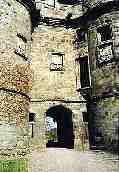 The second of the Stewart kings Robert III was
considered illegitimate by the Church as his parents were so closely
related but was legitimized in 1347 by papal dispensation. He was
considered a feeble or weak king and allowed his advisor the Duke of
Albany to take control. His sons both suffered horrible fates as one was
starved to death in a prison at Falkland
Palace and the other, James I, was captured by pirates and given to
Henry IV of England. He died supposedly of grief saying "I am the
worst of kings and the most miserable of men." He suggested that he
should be buried in a rubbish heap, but was actually buried in Paisley
Abbey!
The second of the Stewart kings Robert III was
considered illegitimate by the Church as his parents were so closely
related but was legitimized in 1347 by papal dispensation. He was
considered a feeble or weak king and allowed his advisor the Duke of
Albany to take control. His sons both suffered horrible fates as one was
starved to death in a prison at Falkland
Palace and the other, James I, was captured by pirates and given to
Henry IV of England. He died supposedly of grief saying "I am the
worst of kings and the most miserable of men." He suggested that he
should be buried in a rubbish heap, but was actually buried in Paisley
Abbey!
James I was born on July 25th, 1394 in
Dunfermline 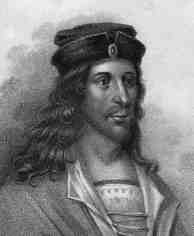 and became king at the age of 12. In an attempt to keep James away from
his uncle, the Duke of Albany, James was sent to France on his accession
in 1406. Unfortunately his ship was captured by the English and James was
taken prisoner and handed over to Henry IV. He was held prisoner for 18
years before finally taking control of Scotland in 1424. The Duke of
Albany remained in charge of Scotland as Governor until his death in 1420
when he was succeeded by his son Murdoch. Upon his return to Scotland,
Robert had Murdoch and several other powerful nobles beheaded. Subsequent
laws restricted the power of the nobles. This did not please the nobles,
especially the Earl of Athol and Sir Robert Graham, and in 1437 they broke
into a party the King was hosting in Blackfriars, Perth and murdered him.
and became king at the age of 12. In an attempt to keep James away from
his uncle, the Duke of Albany, James was sent to France on his accession
in 1406. Unfortunately his ship was captured by the English and James was
taken prisoner and handed over to Henry IV. He was held prisoner for 18
years before finally taking control of Scotland in 1424. The Duke of
Albany remained in charge of Scotland as Governor until his death in 1420
when he was succeeded by his son Murdoch. Upon his return to Scotland,
Robert had Murdoch and several other powerful nobles beheaded. Subsequent
laws restricted the power of the nobles. This did not please the nobles,
especially the Earl of Athol and Sir Robert Graham, and in 1437 they broke
into a party the King was hosting in Blackfriars, Perth and murdered him.
James II was only 6 years old when
crowned king at Holyrood Abbey in 1437. James was known as the 'king of
the fiery face' because of a birthmark but perhaps the 'fiery king' would
have been more appropriate, given the king's temper. William Earl of
Douglas, one of the most powerful nobles in Scotland but also a
troublemaker and dissenter, refused the kings command to 'toe the line',
and was murdered by James with a dagger in a fit of rage! James was
particularly keen on the new weapon of war, the cannon, and at the Siege
of Roxburgh Castle where cannon were used for the first time, it was
ironic that one of them blew him up as he watched close by.
James III was only 9 years old when his
father met his untimely death. Unfortunately, James had a weakness that
was ultimately to lead to his own death: he had favorites upon whom he
would lavish money, land and gifts. This incensed the nobles: they even
imprisoned James at Edinburgh Castle. The nobles succeeded in
setting father against son and at the beginning of the battle of
Sauchieburn on June 11th 1488, Robert, not a good rider, was thrown from
his horse and injured. Taken to the nearest building, a priest was called
to the king: however the man claiming to be the priest stabbed the king
through the heart and then fled before he could be identified.
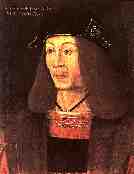
James
IV was racked with guilt about his father's death at Sauchieburn
and did penance every year on the anniversary of the battle. He was a very
clever, learned man, if not lucky in love. James was in love with
Margaret Drummond of Stobshall when it was proposed to him that a marriage
to Margaret Tudor, daughter of Henry VII would improve Anglo-English
relations. The untimely death of Margaret Drummond and her two beautiful
sisters by poison just after the marriage was proposed opened the way to
the alliance some 18 months later. However the marriage did not
bring lasting peace and by 1513 Scotland was at war with England again.
James was annoyed with Henry VIII, now king of England, that he had
refused to send on jewelry that was part of Margaret's marriage dowry and
also that Henry had seized two Scottish ships without reason. With Henry
at war with France, James invaded northern England and The Battle of
Flodden was fought on September 9th 1513. James made a fatal error
by choosing to advance down a steep slippery slope towards the English
forces. His troops slid down the slope in total disarray and were picked
off almost at will by the English. James himself was killed. James V
was just 17 months old when James
IV was killed, his mother Margaret ruling as Regent, followed by the Duke
of Albany who took over as Guardian of the Realm, ruling wisely until his
return to France in 1524 when fighting broke out between the Scottish
nobles. James
spent the first 14 years of his life being passed around from place to
place until in 1526 he was imprisoned in Falkland Palace, finally escaping
in 1528 to begin his rule at the age of 16. He ruled well to begin with
but became tyrannical and obsessed with wealth in later years. His
second wife Mary of Guise gave him two sons who died in infancy, before
giving birth to Mary in the very same week as James lay dying in Falkland
Palace.
Mary was just 6 days old when her father
died. Her mother Mary of Guise 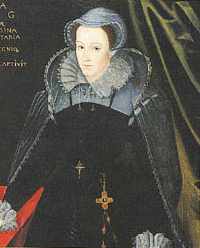 acted as Regent for her daughter during the
turbulent years after her fathers death. At the age of 5 Mary was
betrothed to Francis, son of Henry II of France and sent away to live in
France. A detailed account of her life can be found here:
Suffice to say that her tragic life came to an end when she was accused
of treason and beheaded by her cousin Elizabeth I of England in 1587. acted as Regent for her daughter during the
turbulent years after her fathers death. At the age of 5 Mary was
betrothed to Francis, son of Henry II of France and sent away to live in
France. A detailed account of her life can be found here:
Suffice to say that her tragic life came to an end when she was accused
of treason and beheaded by her cousin Elizabeth I of England in 1587.
With the death of Queen Elizabeth I came the Union
of Crowns, Mary's son James VI of Scotland becoming James I
of England.

|