The original Crkva sv Tripuna (St Tryphon Church) was founded in 809 by Kotor citizen Andreacius (Andrea Saracenis), whose sarcophagus was rediscovered in 1840 and is now on display. The church was consecrated to St Tryphon, martyred in 250 AD at the age of 18 for refusing to recant his faith, whose relics were given to the church by the Byzantine emperor in a ploy to extend his influence into the region. The cult of St Tryphon flourished, and in 1124, when the city council decided to build a new cathedral, it was this site and not the one on Trg od Drva that was chosen. The original Romanesque Basilica was heavily damaged by earthquakes, and the current Baroque exterior, including the non-identical-twin Korčula stone towers, with their incomplete decorations, date from reconstruction work carried out from 1671 until the money ran out in 1683.
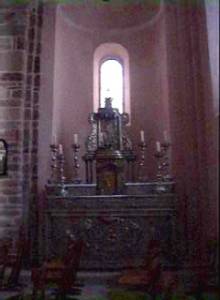
Dominating the interior is the ornate 1362 ciborium of the main altar, carved with a vast array of scenes from the life of St Tryphon that seem to go on far longer than the martyr’s brief life itself. This supports a magnificent silver-gilt altarpiece, bearing reliefs of 20 saints, central of whom is St Tryphon, holding the city of Kotor. Four side-altars contain an early 17th-century Venetian painting of the Blessed Virgin Mary encased in silver, a 17th-century statue of St Rochus, an 18th-century painting of St Nicholas by Pietro Antonio of Venice, and an 18th-century wooden cross, while the 1618 silver altar in the southern apse was the main altar and houses a votive altarpiece from those that survived the 1772 plague.
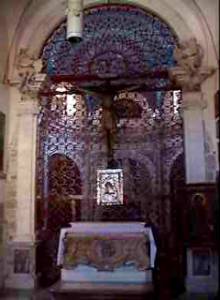
Other artifacts include the 15th-century stone Gothic Pieta, the 16th-century crucifixion by Jacopo de Bassano of Venice, and my personal favourite, a 16th-century painting by Hironim Santa Croce, showing a somewhat anachronistic gathering of St Bartholomew the Apostle with St George and St Antoninus, which I find an unlikely meeting ever to have occurred. The oldest surviving decorations are the fragments of
1331 Greek-style frescos that can still be seen, but the cathedral’s real treasures are upstairs in the reliquary. Decorated in marble by Venetian sculptor Francesco Penso Cabianca from 1704-08 and plundered many times, it is still home to many reliquaries, including the 18th-century golden Reliquary of the True Cross, the 15th-century Capsella Reliquary, bearing a relief of the martyrdom of its occupant, St Tryphon, and the ornate silver Slavia Glava (Glorious Head), originating in the 14th century and containing the skull of St Tryphon.
Main page | Kotor | Montenegro